
With over 30 years in the builders’ merchant trade, Andrew brings deep knowledge of everything from civils to timber. Now part of the Gilmore team, he helps customers make the right choices with advice built on decades of hands-on experience.
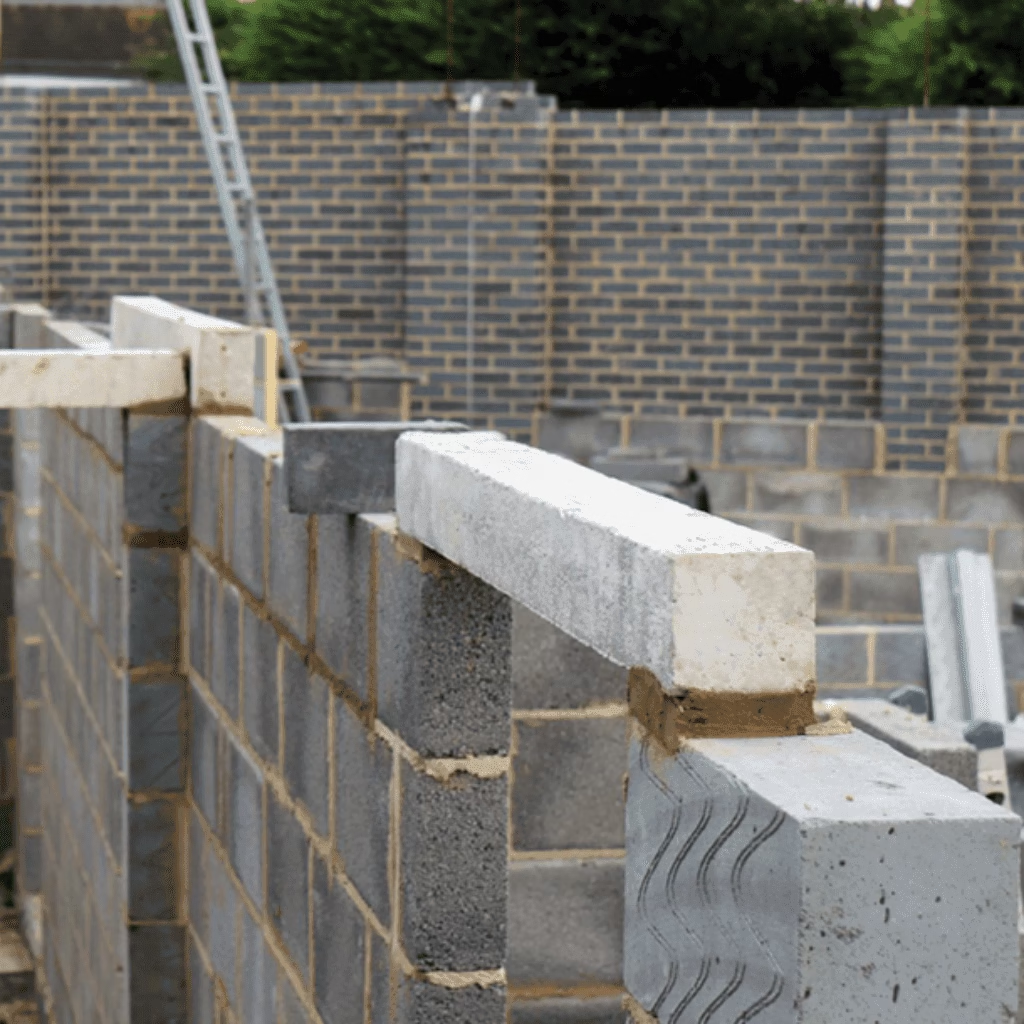
The right choice between a steel lintel and a concrete lintel depends first on the wall type, opening size and load above the opening. Steel lintels are commonly used for cavity walls, solid walls, single-leaf walls and box lintel applications, depending on the lintel type. Concrete lintels are often used for straightforward solid wall, internal masonry and blockwork openings where they are structurally suitable.
If both steel and concrete have been suggested by your builder, architect or structural engineer, compare the total installed cost, not just the purchase price. Weight, access, labour, temporary support, lifting, wall detailing and sign-off requirements can all affect the better-value option.
Do not swap one lintel type for another unless the wall construction, load, span, bearing and manufacturer load data have been checked.
People compare steel and concrete lintels for different reasons. Some are choosing a lintel for a home project and need a clear starting point. Others have already been given more than one option by a builder, architect or engineer and need to decide which option is more practical or cost-effective.
Your first priority is to identify the wall type. A cavity wall, solid wall, single leaf wall and internal blockwork wall may all need different lintel types. The material is not the first decision; the wall construction is.
You also need to consider the opening size, the required bearing at each end of the lintel, and what the lintel needs to support. A lintel above a small internal doorway is not the same as a lintel supporting masonry, floor loads or roof loads above an external opening.
If both steel and concrete have genuinely been allowed for, the decision becomes more about the total installed cost and buildability. That includes product price, delivery, handling, access, lifting, labour, temporary support, lead time and any detailing needed around the wall construction.
In this situation, the question is not simply “which lintel is better?” It is whether the extra cost, handling or detailing of one option is justified by the benefits it gives on that particular job.
Structural alterations need particular care. Temporary support, existing masonry condition, bearing length, load above the opening and the proposed lintel type all matter. If a wall is being opened up, widened or altered, the lintel should be specified by someone competent to assess the structure.
| Factor | Steel lintels | Concrete lintels |
|---|---|---|
| Common uses | Cavity walls, solid wall steel lintels, single leaf walls, box lintels and higher-duty applications depending on product type. | Internal masonry openings, some solid wall openings, garages, blockwork and straightforward applications where suitability is confirmed. |
| Wall compatibility | Available in different forms for different wall constructions, including cavity wall, solid wall, single leaf and box lintel options. | Often suited to simple masonry applications, but not a direct substitute for a purpose-made steel cavity lintel in a modern cavity wall. |
| Product cost | Often more expensive than a basic concrete lintel, especially for cavity wall or higher-duty lintels. | Often lower-cost for standard sizes and straightforward internal or solid wall applications. |
| Installed cost | Can be higher or lower depending on access, profile, duty, detailing, temporary works and handling requirements. | Can be cost-effective, but longer or heavier units may require more labour or mechanical assistance. |
| Handling | Often easier to handle than concrete in some equivalent situations, but this depends on the lintel type and length. | Can be heavy and awkward at longer lengths, which may affect labour and installation cost. |
| Cavity wall detailing | Purpose-made cavity lintels are designed for cavity wall construction, subject to the product type and manufacturer guidance. | A standard concrete lintel does not normally provide the same cavity wall function as a steel cavity lintel. |
| Specification risk | Must match the wall type, span, bearing and required load duty. | Must also match the wall type, span, bearing and required load duty. It should not be chosen simply because it is cheaper. |
Cost is one of the main reasons people compare steel and concrete lintels, but the purchase price does not tell the whole story.
A concrete lintel may be cheaper to buy, especially in standard sizes for simple applications. That does not automatically mean it will be cheaper once installed. Longer concrete lintels can be heavy, awkward to move and more difficult to place, particularly where access is tight or the opening is above ground level.
A steel lintel may cost more as a product, particularly where it is a cavity wall lintel, box lintel or higher-duty lintel. However, in some situations the steel option may be easier to handle, faster to fit, or more suitable for the wall detail. In other cases, the steel lintel may need more careful detailing, temporary support or coordination with the engineer’s specification.
If both options have been suggested as structurally acceptable, ask for a comparison based on the installed cost, not just the lintel price. Include labour, access, delivery, lifting, temporary support, lead time, wall detailing and any Building Control or engineer requirements.
The wall construction is usually the most important starting point. Steel and concrete lintels are not selected by material alone. They are selected by wall type, opening size, load, bearing and the manufacturer’s load data.
For many modern UK cavity wall openings, a purpose-made cavity wall lintel is the correct starting point. A cavity wall has an inner leaf, outer leaf and cavity between them. The lintel has to suit that wall build-up, not just the width of the opening.
A standard concrete lintel is not usually a like-for-like substitute for a steel cavity lintel. It may support one leaf or suit a different wall arrangement, but it will not automatically perform the same role as a cavity lintel designed for the wall construction.
In solid wall construction, both steel and concrete options may be relevant, depending on the wall thickness, load and opening. A solid wall lintel, box lintel or concrete lintel may be suitable in different situations.
The key point is that “solid wall” does not automatically mean “concrete lintel”. The lintel still needs to be selected for the span, bearing and load above the opening.
For single skin walls, outer leaves and some internal masonry applications, a single leaf lintel or concrete lintel may be suitable, depending on the structure and load.
Internal blockwork openings are one of the areas where concrete lintels can be a practical and cost-effective choice, provided the lintel has the correct load capacity and bearing.
A steel lintel may be better value where the product does more than simply bridge the opening. This is especially relevant for cavity walls, higher-duty applications and situations where the wall detail is important.
A concrete lintel may be the more practical and cost-effective choice for straightforward masonry openings where it is structurally suitable.
Do not choose concrete purely because it is cheaper. A lintel that is cheaper to buy but wrong for the wall type, load or cavity detail can create a much more expensive problem later.
The opening width is only part of the lintel decision. The lintel length must allow for adequate bearing at each end, and the required bearing should be checked against the manufacturer’s guidance or the engineer’s specification.
The load above the opening also matters. A lintel supporting a small amount of masonry is not the same as a lintel carrying floor loads, roof loads, concentrated loads or structural alterations. This is why generic rules such as “use steel for this size” or “use concrete for that size” can be misleading.
For broader guidance on choosing a lintel, see Which Lintel Do I Need?
In external cavity walls, the lintel decision is not only structural. Moisture management also matters. Water can enter the outer leaf of masonry and needs a controlled route back out of the wall.
Depending on the wall detail and lintel type, this may involve cavity trays, stop ends and weep vents. Some lintel products may include built-in features or be designed to work with specific cavity arrangements, but this should always be checked against the product specification.
Not without checking. Steel and concrete lintels are not interchangeable just because they are the same length or appear to fit the same opening.
Before swapping one type for another, you need to confirm:
If a structural engineer has specified a particular lintel, the safest approach is to use the specified product or ask the engineer to confirm the alternative in writing.
If you are unsure which lintel is suitable, start with the wall type, opening size and what the lintel needs to support. You can browse the lintels range or contact Gilmore Building Supplies for help finding the right product for your project.
Please note: The information provided on this website is for general guidance only and should not be relied upon as professional advice.
Building methods, material specifications, and regulations can vary depending on location, project design, and site conditions.
Always refer to the latest Building Regulations, manufacturer data sheets, and consult with a qualified structural engineer, surveyor, or building control officer before starting any construction work or making design decisions.
Gilmore Building Supplies accepts no responsibility for loss, damage, or injury resulting from reliance on the information provided.