

Concrete blocks are an essential part of the specification for many construction projects. Making sure we have enough to do the job, without over ordering, is key to meeting budget limits.
Wall area (m²) × 10 = number of blocks required.
Adjust for openings and add 5–10% for waste
For cavity walls, multiply your total by 2, as both inner and outer leaves require blockwork.
And in more detail, here’s our quick guide to getting the numbers right, so your blocks stack up correctly.
Concrete blocks are manufactured to a consistent standard size, so estimating quantities is fairly straightforward. As a general rule of thumb, allow 10 blocks per square metre.
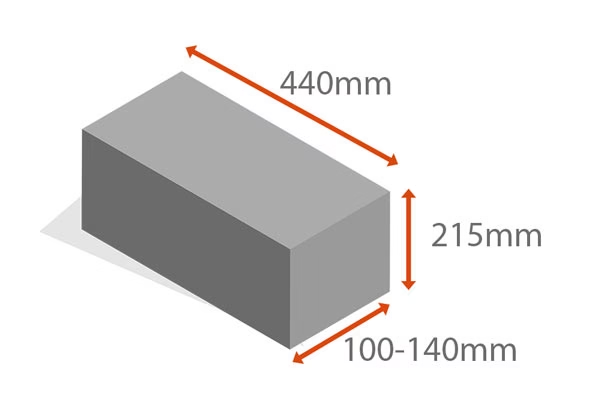
A typical block measures 440mm × 215mm, with thicknesses commonly ranging from 100mm to 140mm.
Once you factor in a standard 10mm mortar joint, the more precise figure comes out at just over 10 blocks per m². In practice, many builders allow up to 12 blocks per m² to account for cuts, wastage, and site conditions.
This is straightforward maths, simply multiply the length of the wall by the height. For example, if your extension is 3m wide by 2.8m high, a quick calculation gives you 8.4m. In this case, if it was a solid wall with no openings in it, we suggest rounding up to 9m to account for cuts and excess.
Door openings usually measure 2100mm x 900mm, which is approximately 2 square metres. Measurements for windows will be on the plans, so you should be able to get an accurate size from them.
The easiest way to do this is to multiply the width and height, this will give you the square meterage required for both leaves. Divide the answer by two for a single leaf.
Foundation blockwork is sometimes referred to by linear metres. As a rule of thumb, you will require 44 blocks for 10 linear metres. This estimation method is useful when there are only a course or two required below ground.
A small 30m2 extension will have at least 16 linear metres of foundations. A twin-leaf course will require two pallets of standard concrete blocks.
The UK average extension size is closer to 40m2, which will mean a requirement for 20 linear metres, or more if there are intermediate foundations to cater to.
Concrete blocks are usually packed and banded for ease of storage, transport and distribution.
Standard size 100mm blocks come on average 72 to a pallet.
This means that a pallet of concrete blocks should be enough to build 7.2m2 of blockwork wall.
140mm Dense Concrete Blocks are wider, so you will only get 48 blocks per pallet on average.
For standard 140mm concrete blocks, you still usually allow 10 blocks per m².
That is because the face size of the block stays the same. The thickness changes, but the height and length do not, so the number of blocks needed per square metre remains broadly unchanged.
There is no single answer, because it depends on the size of the extension, the wall height, the number of openings, and whether it is single-leaf or cavity wall construction.
For a rough guide, a typical 30m² extension might need around 300 to 350 blocks per leaf, before allowing for waste, depending on the layout. If it is a cavity wall build, you would normally need to double that figure to account for both leaves.
The simplest way to estimate is:
Wall area in m² x 10 = approximate number of blocks needed per leaf
Then:
Call us on 01902 366620 or email us today, for expert advice from industry specialists at Gilmore Building Supplies.