
With over 30 years in the builders’ merchant trade, Andrew brings deep knowledge of everything from civils to timber. Now part of the Gilmore team, he helps customers make the right choices with advice built on decades of hands-on experience.
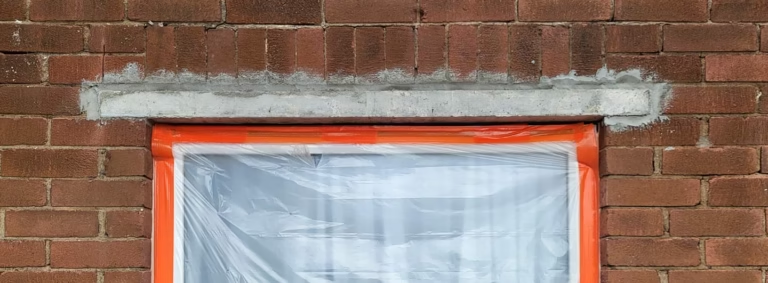
The lintel you need depends on three things, what the wall is made from, whether it’s loadbearing, and what sits above the opening. Everything else flows from that.
For most modern UK houses with cavity walls, a steel cavity lintel is typically used above doors and windows. For internal blockwork or solid masonry walls, a concrete lintel is often appropriate. In some renovation or heritage situations, specialist steel sections or bespoke solutions may be required.
The key point is this:
The lintel must suit the wall construction and the load conditions, not just the width of the opening.
If the wall supports floor joists, roof structure, or additional masonry above, the choice becomes structural rather than cosmetic. When in doubt, and particularly where loads are unclear, you involve a structural engineer or Building Control before proceeding.
This question usually comes up in three common situations:
If you are altering an existing opening in a standard two-storey UK house with brick outer leaf and block inner leaf, you are typically dealing with a cavity wall system. That means a lintel designed to support both leaves of masonry, not just one.
If you’re working internally on blockwork partitions that do not carry structural loads, the decision is simpler. But once an opening is formed in a wall that supports floors, roofs, or masonry above, the lintel becomes a structural element and must be treated accordingly.
A sensible decision starts with identifying the wall type.
Most UK houses built in the last century use cavity construction. That normally means a steel cavity lintel designed to sit across both inner and outer leaves, maintaining cavity insulation and damp protection.
Solid masonry walls may use concrete lintels or structural steel sections depending on the load and thickness.
If the wall supports:
Then it is loadbearing.
Loadbearing openings require more care. The lintel must not only support brickwork above but also structural loads transferred down from the building.
This is where many DIYers underestimate what’s happening above the plasterboard. You may not see the load, but it’s there.
Loads increase significantly when you have:
The taller and heavier the structure above, the more important correct lintel selection becomes.
While span matters, it should never be the only deciding factor. A 1.2m opening in a lightly loaded internal wall is very different from a 1.2m opening in a two-storey cavity wall supporting roof structure.
Lintel manufacturers publish span tables, but those are design documents, not guesswork tools. If you are unsure how to interpret them, that is the point to involve professional advice.
Generally, no, not unless the cavity is narrow and the lintel is specifically designed for that construction. Standard concrete lintels are usually intended for single-leaf masonry. In modern cavity walls, steel cavity lintels are typically preferred because they support both leaves and maintain damp protection.
If you are altering a loadbearing wall, creating a new opening, or widening an existing one, the answer is usually yes. Even in domestic projects, Building Control will often require structural justification for new structural openings.
Replacing a like-for-like lintel in a non-structural situation may not require engineering input, but once structural load paths are changed, professional involvement becomes necessary.
A standard steel lintel generally supports a single leaf of masonry. A cavity lintel is designed to span across both leaves of a cavity wall and may include features to manage insulation, damp proofing, and thermal bridging.
They are not interchangeable.
You should involve a structural engineer where:
Building Control may also request structural calculations before approving works.
Engineers are not there to complicate the job. Their role is to ensure that load paths remain safe and that the building performs as intended long term.
Once the structural type is established, there are practical factors to consider when purchasing:
Avoid buying purely on price. A lintel is a structural component, it must suit the wall system and the load condition first.
Choosing the right lintel comes down to understanding:
In modern cavity walls, steel cavity lintels are typically required. In single-leaf masonry, concrete lintels may be appropriate. The more structural load involved, the more important correct specification becomes.
If you are forming or altering a loadbearing opening, involve a structural engineer and notify Building Control. If you are unsure about load conditions or construction type, pause and confirm before proceeding.
A lintel is not just a piece of metal or concrete over a gap. It is part of the building’s structural system, and it needs to be chosen accordingly.
Please note: The information provided on this website is for general guidance only and should not be relied upon as professional advice.
Building methods, material specifications, and regulations can vary depending on location, project design, and site conditions.
Always refer to the latest Building Regulations, manufacturer data sheets, and consult with a qualified structural engineer, surveyor, or building control officer before starting any construction work or making design decisions.
Gilmore Building Supplies accepts no responsibility for loss, damage, or injury resulting from reliance on the information provided.